
Aïcha Touré, a 32-year-old mother of five, was in Kankan when her phone rang. She was with her children at the hospital at the bedside of her ill husband, 70km away from her home in Koumana. It was the kind of trip that takes most of the day and leaves little room for anything else on your mind. Her baby was due for another vaccine back in Koumana. She hadn’t come in yet. And someone noticed.
On the other end of the line was her Community Relay from Koumana, Ramata Bangoura, who had accompanied Aïcha through her pre- and postnatal care for her last child. While reviewing her patient follow ups with Kendeya, the digital health app used by Community Relays, she noticed the upcoming appointment for Aicha’s baby. Ramata picked up the phone.
Ramata’s message was simple: your child’s vaccine appointment is coming up, and we haven’t heard from you yet, but don’t worry, we can do it when you’re back.
Before Integrate Health arrived in Kouroussa, Aicha wouldn’t have received a follow up call to flag her baby’s progress. Families had to navigate care on their own, traveling long distances to health centers and managing out-of-pocket health expenses. Now, more pregnancies can be recorded and monitored. Children’s vaccination schedules are more systematically followed. And if someone misses their appointment, there is a Community Relay or Community Health Worker there to help them get back on track.
This change would not exist without partners like Gavi, the Vaccine Alliance. Since 2023, support provided through Gavi and its Matching Fund partners, including contributions from the Kingdom of the Netherlands and The Church of Jesus Christ of Latter-day Saints, has enabled Integrate Health to accompany the Government of Guinea to strengthen community-based approaches that help expand vaccination coverage for zero-dose and under-vaccinated children through the Integrated Primary Care Program (IPCP).
Rooted in the community, reaching every door
Barriers to vaccination are complex. Health facilities are often hours away on foot; health centers are understaffed, and, for families whose income depends on not missing a day of farming or mining, a trip to a health center is a real economic sacrifice. Before the IPCP, Aïcha paid 10,000 Guinean francs ($1.14 USD) in consultation fees for every vaccine appointment. She would travel to the health center only to then be told she had arrived days or weeks too early. Vaccine hesitancy adds another layer: like many mothers, Aïcha used to dread the fever that sometimes followed a shot and would hesitate before getting her child vaccinated.
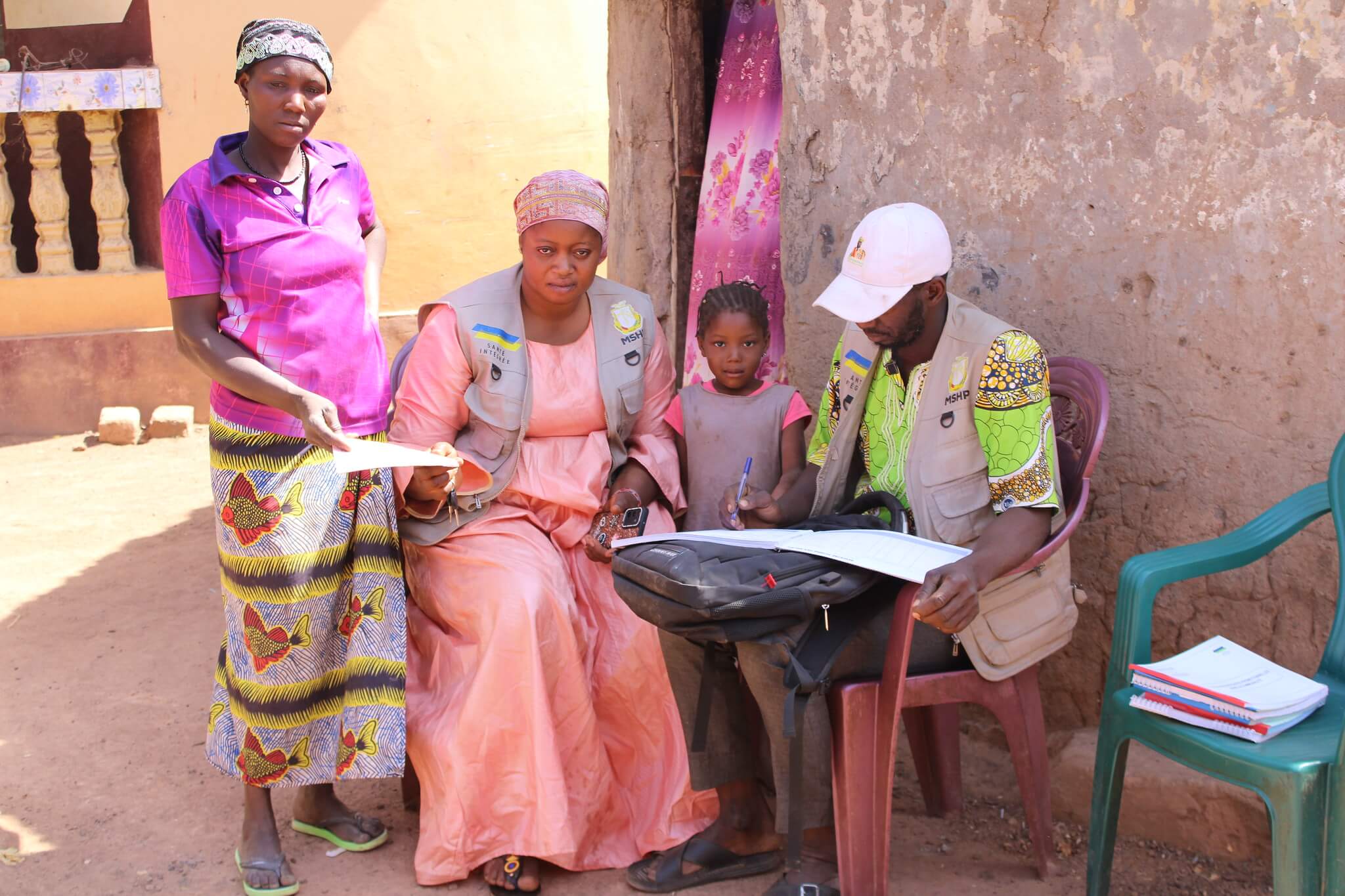
Community Relays like Ramata understand these barriers and work with families to overcome them. They know when the mines are closed and parents are at home and they plan their visits accordingly. They know which families have moved, which mothers delivered last month, and which children are one dose short of complete protection from disease. They continue to show up. And they follow up.
What happens when the system works
When Aïcha returned from Kankan, she brought her youngest child to the health center. She had kept every prenatal appointment, delivered her baby safely, and watched her newborn grow healthy. But it wasn’t always the case. Before the IPCP was within reach, she had given birth at the health center but had not had the kind of pre- or post-natal follow up Ramata provided. With Ramata’s support, she had four pre-natal visits to prepare for the birth and had prepared a birth plan in collaboration with her husband under Ramata’s guidance. Today, Ramata regularly meets with mothers in Koumana to talk about the importance of vaccination, address their concerns, and remind them that healthcare for children under five is free. For Aïcha, those conversations made all the difference. She no longer hesitates.
Aïcha’s story reflects the kind of support the IPCP aims to provide. Since Integrate Health, Gavi and its Matching Fund parters came together with the Government of Guinea in 2023, the results speak for themselves. By May 2025, 87% of children in Kouroussa district had received three doses of the pentavalent vaccine, surpassing the annual target of 80%. From December 2023 to December 2025, community health workers vaccinated 686 zero-dose children, 4,037 under-vaccinated children, and 11,732 pregnant women.
Building on that foundation, Integrate Health and the Government of Guinea are now scaling this model with continued Gavi and Matching Fund partner support, including the rollout of 880,000 doses of the malaria vaccine, enough to fully protect 220,000 children. The Community Relays and Community Health Workers driving that effort will do what they always do: find the families the system hasn’t reached yet and make sure no child is left behind.
“Now, when our children get sick, we know they receive care and medication free of charge at the health center,” Aïcha says. For her, that phone call was not a small thing. It was proof that her child’s name was on a list, that someone in her own community was paying attention, and that she wasn’t the only one watching over him.
Behind every number in this story is a health system that responds. That follows up. That picks up the phone.
This work by Integrate Health was facilitated by The Church of Jesus Christ of Latter-day Saints and accepted and funded by Latter-day Saint Charities Australia.