

What does it take to build a reliable health data system for programs in the hardest-to-reach communities? How do we know it is consistent across country programs, useful for our government partners, and rigorous? And as programs scale across borders, how do we make sure we’re measuring the same things, in the same ways, over time?
These questions have shaped our work for years as members of Integrate Health’s Monitoring, Evaluation, and Quality Improvement (MEQI) team. They reflect a central tension in generating programmatic data: systems that function well on smaller scales are often challenged when programs grow. Scaling doesn’t just increase volume; it challenges definitions, workflows, and the assumptions embedded in how data are collected and used. Unlike research-based data collection, with controlled conditions and dedicated resources, our programmatic data happens within the messy reality of real-time healthcare delivery.
When Integrate Health’s program expanded into Guinea in 2023, we knew that our data system would need to change alongside it. We expected to adapt it but didn’t yet fully understand how profoundly context would shape data quality, comparability, and system design.
These challenges led us to visit Guinea in February 2025. Ahead of our visit, colleagues in Guinea requested targeted support to clarify how Community Health Worker (CHW) visits and activities were being defined and counted. An initial review had surfaced discrepancies in how certain visit categories were recorded, pointing to a broader challenge: definitions were not yet consistently aligned with national guidelines or with Integrate Health’s program expectations.
Our goal was straightforward: clarify definitions, understand current practices, and work with our teams to address the gaps and challenges and ensure our data system remains robust and reliable. To do this, we leveraged our lessons learned from Togo and collaborated closely with local staff and stakeholders to recalibrate our data system for future success.
Lessons from Togo: building before scaling
Our experience in Togo provided an essential foundation for what would later become cross-country scale. The Integrated Primary Care Program (IPCP) began in a single pilot district in the Kara region of northern Togo. This approach gave teams time and proximity to the field to really understand programmatic data functions in practice—how it is collected, who collects it, and where pain points are in the system.
Over time we were able to clarify definitions, align indicators, and build routines that could withstand growth. Critically, this work was carried out in close alignment with national data systems. Rather than creating a parallel system, we anchored our indicators in the national DHIS2 framework, with additional programmatic indicators defined only where necessary to support organizational decision-making.
As the program expanded to additional districts in the Kara region, the volume and complexity of data increased accordingly. It outpaced what we could manage manually, and our old system of spreadsheets quickly became unsustainable. Tools like Tableau and Alteryx became critical for managing this complexity. They allowed teams to work effectively with national datasets, clean and transform data systematically, and identify trends that could inform both operational and strategic decisions.
Equally important was successfully getting buy-in from everyone on the team—people understood why we needed to evolve, even though it meant their jobs would shift away from data entry. This allowed teams to move towards higher-level analysis and strategic interpretation, strengthening the connection between implementation and evidence.
The Togo experience wasn’t without its challenges. CHWs and health facilities didn’t always use the same approaches or interpret data collection tools the same way. Some data was incomplete or unreliable, requiring multiple rounds of verification to avoid creating parallel data sets. And crucially, we had to avoid overburdening CHWs and other frontline health workers who were already stretched thin.
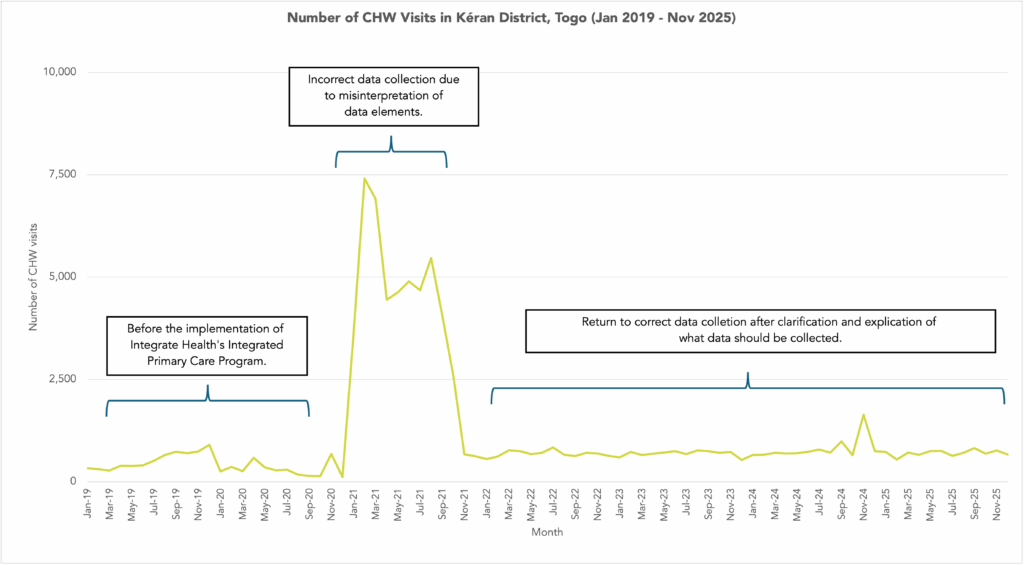
In the end, the iterative work of testing, adjusting, and learning resulted in a system that was resilient and adaptable. This foundation proved critical as Integrate Health began expanding beyond Togo’s borders.
Expanding to Guinea: when context reshapes a system
When Integrate Health began programming in Guinea, we had tools, shared definitions, and indicators adapted from Togo, in addition to experienced local staff. What quickly became clear, however, was the level of complexity this new context introduced.
First, Guinea’s geography was daunting, with implementation sites sometimes 80km apart, compared to 13km in Togo. Second, a full monitoring and evaluation (M&E) team was not in place at the start of data collection due to staffing challenges. Therefore, staff members were stretched thin and were unable to consistently provide in-person support for CHWs and Community Relays collecting data or perform data quality checks to ensure harmony with sets coming from Togo.
Once we understood these two key challenges, we knew the approach developed in Togo couldn’t be simply transferred.
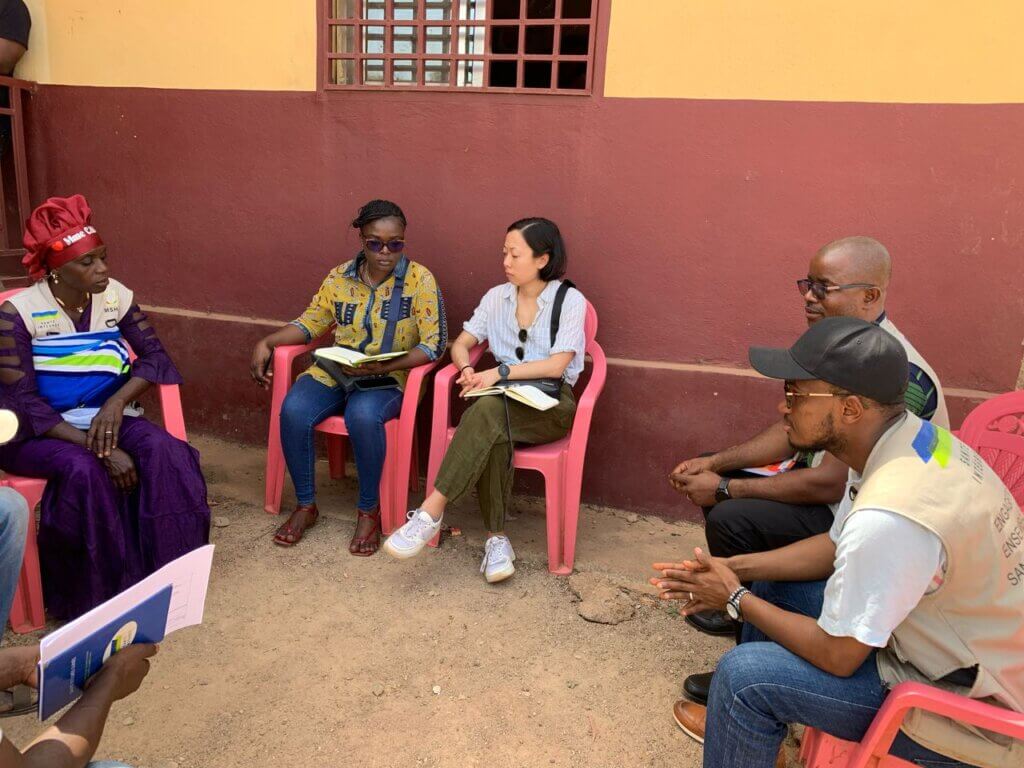
During the 2025 February trip, we made concrete progress. Understanding the data collection and processing steps in theory is one thing. Seeing it in person—taking a ferry and hours—long drive to visit a health center, sitting with our Guinea team members as they explained their difficulties—made all the difference.
When we reviewed their reports remotely, we often had questions about patterns or anomalies in the data. Being there in person helped us answer those questions and co-create a way forward. We clarified the difference between a CHW action and visit. We walked through the entire process from data collection at the community level through processing to our dashboards. By grounding discussions in both prior experience and local context, teams were able to agree on practical adaptations that strengthened data quality and comparability while remaining feasible on the ground.
CHW visit: The total number of times the Community Relay or Community Health Worker visits and carries out an activity (consultation or education session) in a household. Multiple actions may be completed on one visit.
CHW action: The total number of consultations, education sessions, and active case-finding carried out by a CHW
Looking back and looking ahead
This cross-country experience reinforced several key insights.
Strong data systems are built over time. Early investment in defining terms, aligning with national systems, and selecting analytical tools creates the conditions for scale, but those systems must remain flexible as context changes.

Cross-border expansion is fundamentally different from within-country scale. Even when program models are shared, local context reshapes how data are collected, interpreted, and used. Adaptation is not a sign of weakness in a system; it is a requirement for maintaining quality.
Finally, tools and processes matter, but people matter more. The ability to move quickly, listen carefully, and raise concerns early depends on trust, shared ownership, and strong collaboration across teams.
The good news? Looking ahead, work continues to strengthen data quality in Guinea through sustained engagement, training, and documentation. A shared dashboard now allows us to compare data across both countries, and lessons from this process will be critical to inform future expansion.
As we return from our late January 2026 trip to Togo and think about the months ahead, we feel genuinely hopeful.
Quality programmatic data isn’t just about numbers in a spreadsheet. It’s about understanding whether our work is actually improving health outcomes for the communities we serve. It’s about being accountable to our donors, our partners, and most importantly, to the patients and families who depend on strong health systems.
And that’s what keeps us going.